
Creality K1C 3D Printer Review: Ultra-Fast CoreXY Printing with Carbon Fiber Support
IR Sensor Working and Applications: A Complete Guide to Infrared Sensors
Infrared (IR) sensors are one of the most commonly used electronic sensors in modern technology. These sensors play an important role in automation, robotics, security systems, and many smart devices that we use daily. From TV remote controls to obstacle detection in robots, infrared sensors help detect objects and measure distances using infrared radiation.
In electronics and robotics projects, IR sensors are widely used for object detection, line-following robots, motion detection, and proximity sensing. Due to their low cost, simple design, and high efficiency, they are popular among engineers, students, hobbyists, and automation developers.
In this article, we will explore the working principle of IR sensors, their components, types, advantages, and applications in various industries.
What is an IR Sensor?
An Infrared Sensor (IR Sensor) is an electronic device that detects infrared radiation emitted by objects in its surrounding environment. Infrared light is part of the electromagnetic spectrum and is invisible to the human eye but can be detected by electronic sensors.
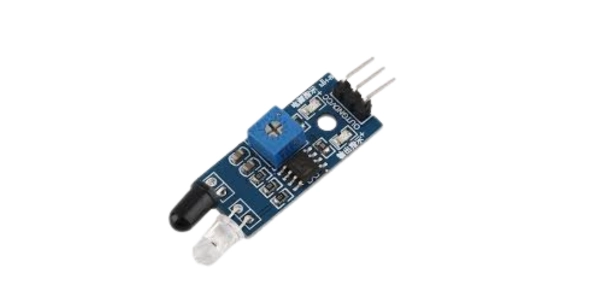
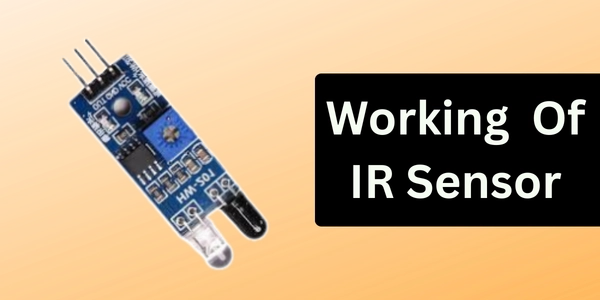
The basic function of an IR sensor is to emit infrared light and detect the reflected radiation from nearby objects. When an object comes close to the sensor, the infrared light reflects back to the receiver, allowing the sensor to detect its presence.
Because of this ability, IR sensors are commonly used in proximity sensing, obstacle detection, and motion sensing systems.
Components of an IR Sensor Module
A typical IR sensor module consists of several key components that work together to detect objects.
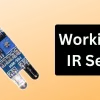
IR Transmitter (IR LED)
The IR transmitter is usually an infrared LED that emits infrared light. This light is projected into the surrounding environment.
IR Receiver (Photodiode or Phototransistor)
The IR receiver detects the infrared radiation that reflects from objects. When the reflected light is detected, it generates an electrical signal.
Comparator Circuit
The comparator processes the signal received from the IR receiver and determines whether an object is detected.
Potentiometer
Many IR sensor modules include a potentiometer that allows users to adjust the sensitivity or detection range of the sensor.
Indicator LEDs
Most modules include LEDs that indicate power status and object detection.
These components work together to create a simple but effective sensing system.
Working Principle of IR Sensor
The working principle of an IR sensor is based on the reflection of infrared light.
The process works in the following steps:
-
The IR transmitter emits infrared radiation into the surrounding area.
-
When an object enters the detection range, the infrared light reflects from the object’s surface.
-
The IR receiver detects the reflected radiation.
-
The signal is sent to a comparator circuit, which processes the signal.
-
If the reflected signal crosses the threshold level, the sensor triggers an output signal indicating object detection.
This output signal can then be used to control microcontrollers such as Arduino, Raspberry Pi, or other embedded systems.
Because of this simple working mechanism, IR sensors are widely used in robotics, automation systems, and smart electronics.
Types of IR Sensors
Infrared sensors are mainly categorized into two types depending on their functionality.
Active IR Sensors
Active IR sensors consist of both an IR transmitter and IR receiver. The transmitter emits infrared light, and the receiver detects the reflected light from objects.
These sensors are commonly used in:
-
Obstacle detection systems
-
Line-following robots
-
Proximity detection
Passive IR Sensors (PIR Sensors)
Passive IR sensors do not emit infrared radiation. Instead, they detect infrared radiation emitted by objects such as humans or animals.
These sensors are widely used in:
-
Motion detection systems
-
Security alarms
-
Automatic lighting systems
Advantages of IR Sensors
IR sensors offer several advantages that make them widely used in electronics and automation.
Low Cost
Infrared sensors are affordable and easily available, making them ideal for educational projects and industrial applications.
Simple Design
The sensor modules are compact and easy to integrate with microcontrollers and embedded systems.
Low Power Consumption
IR sensors consume very little power, which makes them suitable for battery-powered devices.
Fast Response Time
They can detect objects quickly, making them suitable for real-time applications.
Reliable Detection
IR sensors work effectively in many environments and provide consistent performance for short-distance detection.
Applications of IR Sensors
Infrared sensors are used in a wide range of applications across different industries.
Robotics and Automation
IR sensors are widely used in robotics projects for obstacle detection and navigation. Robots use these sensors to avoid collisions and move intelligently in their environment.
Line Following Robots
One of the most popular educational projects using IR sensors is the line-following robot, where the sensor detects black lines on a white surface and guides the robot accordingly.
Remote Control Systems
Infrared sensors are used in TV remote controls, air conditioners, and home entertainment systems to transmit signals between the remote and the device.
Security Systems
IR sensors are used in motion detection and burglar alarm systems to detect human movement.
Automatic Doors
Many automatic doors in malls and offices use infrared sensors to detect approaching people and open automatically.
Industrial Automation
In manufacturing industries, IR sensors help detect objects on conveyor belts and assist in automated sorting systems.
Smartphones and Smart Devices
Modern smartphones use IR sensors for proximity detection during calls and gesture recognition features.
IR Sensors in Robotics Projects
In robotics and electronics learning, IR sensors are one of the first sensors that beginners use. They are commonly used with microcontrollers like Arduino, Raspberry Pi, and ESP32 to build innovative projects.
Some popular robotics projects using IR sensors include:
-
Line follower robot
-
Obstacle avoidance robot
-
Automatic hand sanitizer dispenser
-
Smart parking system
-
Object counting systems
These projects help students understand the basics of sensors and automation.
Why Buy IR Sensors from Roboucreate?
If you are looking for high-quality IR sensors, robotics components, and electronic modules, Roboucreate is the ideal platform for makers, students, and engineers.
Roboucreate offers:
- High-quality electronic components
- Robotics modules for learning and innovation
- Affordable pricing for students and hobbyists
- Fast shipping across India
- Reliable technical support


Add comment