
Ultrasonic Sensor Working Principle: Complete Guide to Ultrasonic Distance Sensors
Ultrasonic Sensor Working Principle: Complete Guide to Ultrasonic Distance Sensors
Ultrasonic sensors are widely used electronic devices that measure distance and detect objects using high-frequency sound waves. These sensors play a crucial role in modern technologies such as robotics, industrial automation, smart parking systems, obstacle detection, and distance measurement applications.
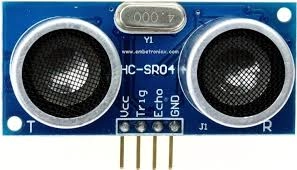
One of the most popular ultrasonic sensors used in electronics and robotics projects is the HC-SR04 ultrasonic sensor, which is commonly used with microcontrollers like Arduino, Raspberry Pi, and other embedded systems.
Ultrasonic sensors are highly reliable because they can detect objects without physical contact and work effectively in various environmental conditions. In this article, we will explore the working principle of ultrasonic sensors, their components, advantages, and real-world applications.
What is an Ultrasonic Sensor?
An ultrasonic sensor is an electronic device that measures the distance between the sensor and an object using ultrasonic sound waves. These sound waves have frequencies higher than 20 kHz, which are beyond the hearing range of humans.
The sensor works by emitting ultrasonic waves and measuring the time taken for the waves to reflect back after hitting an object. Using this time measurement, the sensor calculates the distance between the sensor and the object.
Because of this accurate measurement capability, ultrasonic sensors are widely used in distance measurement systems, robotics, automation systems, and vehicle parking assistance technologies.
Components of an Ultrasonic Sensor
A typical ultrasonic sensor module consists of several important components that work together to detect objects and measure distance.
Ultrasonic Transmitter
The transmitter emits high-frequency ultrasonic sound waves into the surrounding environment. These waves travel through the air until they hit an object.
Ultrasonic Receiver
The receiver detects the reflected sound waves (echo) after they bounce back from the object.
Control Circuit
The control circuit processes the transmitted and received signals and calculates the time taken for the echo to return.
Trigger and Echo Pins
Most ultrasonic sensors, such as the HC-SR04, have two main pins:
-
Trigger Pin – Used to send the ultrasonic signal
-
Echo Pin – Used to receive the reflected signal
These pins communicate with microcontrollers to measure the distance accurately.
Working Principle of Ultrasonic Sensor
The working principle of an ultrasonic sensor is based on the echo or reflection of ultrasonic sound waves.
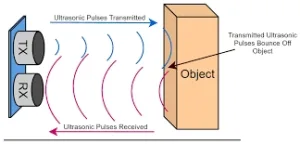
The operation can be explained in the following steps:
-
The sensor sends a trigger signal to the ultrasonic transmitter.
-
The transmitter emits ultrasonic sound waves into the environment.
-
These sound waves travel through the air until they hit an object.
-
The sound waves reflect back from the object toward the sensor.
-
The receiver detects the returning sound waves (echo).
-
The sensor measures the time taken for the echo to return.
-
Using the speed of sound in air, the sensor calculates the distance.
Distance Calculation Formula
Distance is calculated using the formula:
Distance = (Speed of Sound × Time) / 2
The division by two is necessary because the sound wave travels to the object and back to the sensor.
This method allows ultrasonic sensors to measure distance accurately.
Features of Ultrasonic Sensors
Ultrasonic sensors have several features that make them ideal for various applications.
Non-Contact Measurement
The sensor measures distance without touching the object, preventing wear and damage.
High Accuracy
Ultrasonic sensors provide reliable and accurate distance measurements.
Works in Low Light Conditions
Unlike optical sensors, ultrasonic sensors work effectively even in dark environments.
Wide Detection Range
Many ultrasonic sensors can measure distances from 2 cm to several meters.
Easy Integration
They can be easily connected with microcontrollers such as Arduino, Raspberry Pi, and ESP32.
Applications of Ultrasonic Sensors
Ultrasonic sensors are used in many modern technologies and industrial systems.
Robotics
Ultrasonic sensors are widely used in obstacle avoidance robots. Robots use these sensors to detect nearby objects and avoid collisions.
Distance Measurement Systems
They are used to measure distance in engineering projects and automation systems.
Vehicle Parking Assistance
Many modern vehicles use ultrasonic sensors in parking assistance systems to detect nearby obstacles.
Water Level Monitoring
Ultrasonic sensors can measure the level of liquids in tanks and reservoirs without direct contact.
Industrial Automation
Factories use ultrasonic sensors for object detection, material handling, and conveyor belt monitoring.
Smart Home Systems
Ultrasonic sensors are used in automatic lighting systems and motion detection devices.
Advantages of Ultrasonic Sensors
Ultrasonic sensors offer several benefits compared to other types of sensors.
High Reliability
They provide consistent performance in different environmental conditions.
Accurate Distance Measurement
They can measure distances with high precision.
Works with Different Materials
Ultrasonic sensors can detect objects made of metal, plastic, glass, wood, and liquids.
Low Power Consumption
They consume very little power, making them suitable for portable and battery-powered devices.
Affordable and Easy to Use
Ultrasonic sensors such as the HC-SR04 are inexpensive and easy to integrate into electronics projects.
Ultrasonic Sensors in Robotics Projects
Ultrasonic sensors are one of the most popular sensors used in robotics and IoT projects. Students and hobbyists frequently use them to build smart automation systems.
Some popular projects include:
-
Obstacle avoidance robot
-
Smart parking system
-
Automatic water level monitoring
-
Distance measurement device
-
Smart trash bin
These projects help learners understand the fundamentals of sensors and automation technologies.
Why Buy Ultrasonic Sensors from Roboucreate?
If you are looking for high-quality ultrasonic sensors and robotics components, Roboucreate offers reliable electronics products for makers, engineers, and students.
Roboucreate provides:
- High-quality ultrasonic sensor modules
- Robotics and electronics components
- Affordable pricing for students and hobbyists
- Fast delivery across India
- Technical support for projects
Whether you are building robotics systems, automation devices, or electronics projects, Roboucreate provides the tools needed to bring your ideas to life.
Conclusion
Ultrasonic sensors are powerful and versatile devices used for distance measurement and object detection. Their working principle based on the reflection of ultrasonic sound waves allows them to measure distances accurately without physical contact.
With applications in robotics, industrial automation, smart vehicles, water level monitoring, and smart home systems, ultrasonic sensors are essential components in modern technology.
Because of their reliability, accuracy, and ease of use, ultrasonic sensors continue to be widely used in electronics projects and industrial systems.


Add comment