
What Is 3D Printing? Complete Guide to Working, Types, Software & Printing Process
3D Printing, also known as Additive Manufacturing, is one of the most revolutionary technologies transforming industries across the globe. From rapid prototyping to full-scale production, 3D printing allows users to create three-dimensional objects layer by layer using digital designs.
Whether you are a student, engineer, manufacturer, or hobbyist, understanding how 3D printing works and its complete process can help you unlock unlimited innovation possibilities.
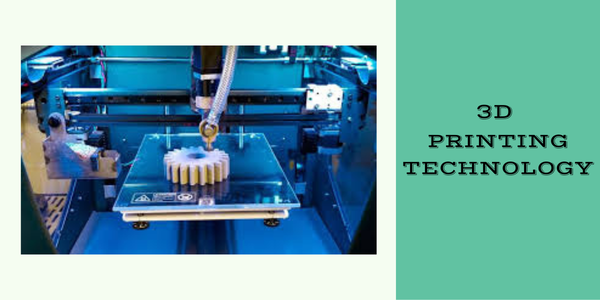
What Is 3D Printing?
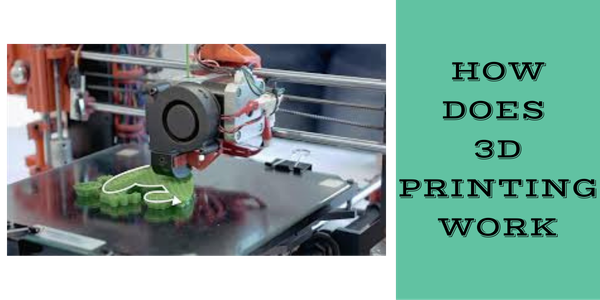
3D printing is a manufacturing process where a digital 3D model is converted into a physical object by depositing material layer by layer. Unlike traditional subtractive manufacturing (cutting or drilling), 3D printing builds objects by adding material only where needed, making it efficient and cost-effective.
The concept of 3D printing was introduced in the 1980s by Chuck Hull, who developed the first technology called Stereolithography (SLA).
Today, 3D printing is widely used in industries like aerospace, healthcare, automotive, robotics, education, architecture, and consumer electronics.
1. Subtractive Manufacturing Process
The Subtractive Manufacturing Process is a traditional production method where material is removed from a solid block to create the desired shape and size. This process uses machines like CNC mills, lathes, drills, and grinders to cut away excess material with high precision.
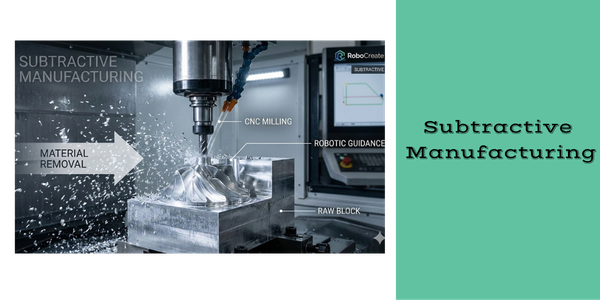
It is widely used in industries such as automotive, aerospace, and mechanical engineering for producing strong and accurate components. Unlike additive manufacturing, which builds objects layer by layer, subtractive manufacturing shapes parts by cutting and carving. This method is ideal for mass production and high-strength metal parts requiring tight tolerances and smooth finishes.
2. Forming Manufacturing Process
The Forming Manufacturing Process is a production method where materials are shaped into desired forms without removing or adding material. It works by applying mechanical force such as compression, tension, or bending to deform the material permanently.
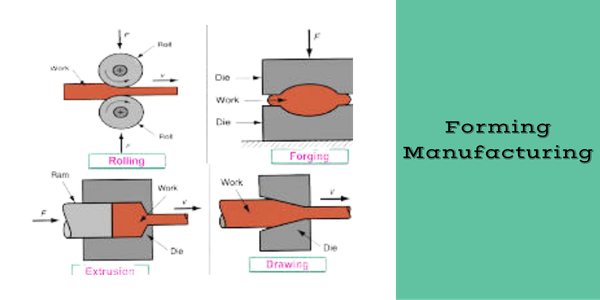
Common forming processes include forging, rolling, extrusion, and stamping. This method is widely used in automotive, construction, and metal industries to produce strong and durable components. Forming improves material strength by refining its internal grain structure while maintaining high production efficiency.
3. Casting Manufacturing Process
The Casting Manufacturing Process is a production method in which molten material, usually metal, is poured into a mold cavity and allowed to solidify into the desired shape. Once cooled, the solidified part is removed from the mold and finished if necessary.
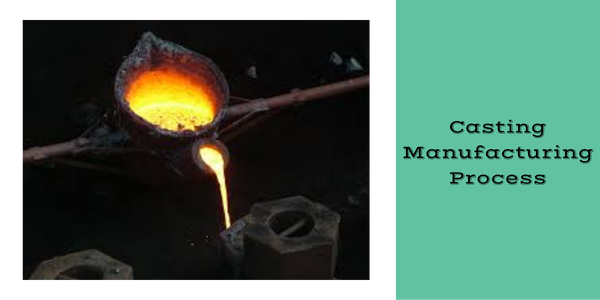
Casting is widely used to produce complex shapes that are difficult to manufacture using other methods. Common casting techniques include sand casting, die casting, and investment casting. This process is essential in industries like automotive, aerospace, and heavy machinery for creating durable and high-strength components.
4. Additive Manufacturing process
The Additive Manufacturing Process is a modern production method where objects are created by adding material layer by layer based on a digital 3D design. Unlike traditional manufacturing, it does not remove material but builds parts precisely where needed.
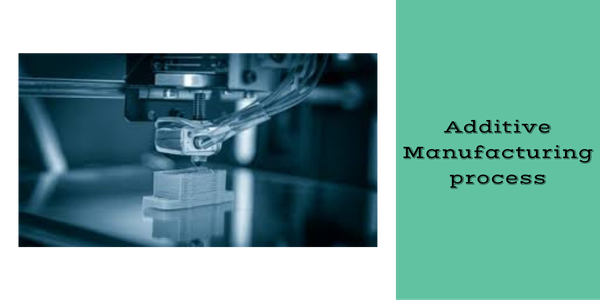
This process is commonly used in 3D printing technologies for rapid prototyping and customized production. Additive manufacturing allows complex geometries, lightweight structures, and minimal material waste. It is widely applied in industries such as aerospace, healthcare, automotive, and product design for innovation and efficiency.
1. 3D Model
A 3D Model is a digital representation of a physical object created using specialized design software. It defines the shape, size, and structure of an object in three dimensions — length, width, and height. 3D models are designed using CAD (Computer-Aided Design) software and are commonly saved in formats like STL or OBJ for 3D printing and manufacturing. These models can include detailed features, textures, and measurements for precise production. 3D models are widely used in engineering, architecture, gaming, animation, and 3D printing industries.
- Fusion 360
- Autodesk Inventor
- SolidWorks
- Catia
Fusion 360
Fusion 360 is a powerful cloud-based CAD, CAM, and CAE software used for 3D modeling, product design, and engineering. It allows users to design, simulate, and manufacture products within a single integrated platform. Fusion 360 is widely used by engineers, startups, and students for 3D printing, CNC machining, and mechanical design projects.
Solid Works And Autodesk Inventor
SolidWorks is a professional 3D CAD software widely used for mechanical design, product development, and engineering simulations.
Autodesk Inventor is advanced 3D mechanical design software used for product simulation, sheet metal design, and tool creation. It helps engineers design, visualize, and test products before manufacturing, improving accuracy and efficiency.
Catia
CATIA is an advanced 3D CAD, CAM, and CAE software widely used in aerospace, automotive, and industrial design industries. It provides powerful tools for product design, surface modeling, engineering analysis, and system integration. CATIA is especially popular for designing complex and high-precision components in large-scale engineering projects.
2. Slicing Process
The Slicing Process is a crucial step in 3D printing where a 3D model is converted into printable instructions for the printer. During this process, slicing software divides the digital model into hundreds or thousands of thin horizontal layers. It also generates G-code, which controls printer movements, temperature, speed, and material flow.
Settings like layer height, infill density, print speed, and support structures are adjusted in this stage. The slicing process ensures accurate printing and directly affects the quality, strength, and printing time of the final object.
3. Transferring the data to 3D printing machines.
Transferring the Data to 3D Printing Machines is the step where the generated G-code file from the slicing software is sent to the 3D printer for execution. The data can be transferred using an SD card, USB cable, Wi-Fi, or cloud-based connectivity, depending on the printer model. Once the file is loaded, the printer reads the instructions and begins the layer-by-layer printing process. Proper file transfer ensures accurate communication between the software and the machine. This step is essential for smooth operation and successful 3D printing results.
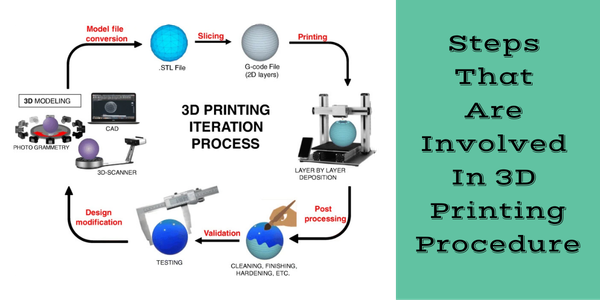
The 3D printing procedure follows a systematic process to convert a digital idea into a physical object. Below are the key steps involved:
-
Designing the 3D Model
Create the object using CAD software or download a ready-made 3D model file. -
Exporting the File (STL/OBJ Format)
Save the design in a compatible 3D printing file format like STL or OBJ. -
Slicing the Model
Use slicing software to divide the model into thin layers and generate G-code instructions. -
Transferring the File to the Printer
Transfer the G-code file via SD card, USB, Wi-Fi, or cloud connection. -
Printer Setup
Load the material (filament/resin), level the print bed, and set the required temperature. -
Printing the Object
The printer builds the object layer by layer according to the G-code instructions. -
Post-Processing
Remove support structures, clean, sand, polish, or cure the printed part if needed.
3D Printing Industry
The 3D Printing Industry is one of the fastest-growing sectors in modern manufacturing, driven by innovation in additive manufacturing technologies. It enables companies to produce prototypes, custom parts, and complex components with reduced cost and faster turnaround time. Industries such as aerospace, automotive, healthcare, construction, education, and consumer electronics widely adopt 3D printing for efficient production and product development.
Types of 3D Printing Technology
There are several types of 3D printing technologies used across industries, each based on different materials and working principles. Below are the main types:
- Vat Photopolymerization
- Stereolithography (SLA)
- Digital Light Processing (DLP)
- Continuous Liquid Interface Production (CLIP)
- Material Jetting
- Binder Jetting
- Material Extrusion
- Fused Deposition Modeling (FDM)
- Fused Filament Fabrication (FFF)
- Powder Bed Fusion (Polymers)
- Selective Laser Sintering (SLS)
- Powder Bed Fusion (Polymers)
Material Extrusion
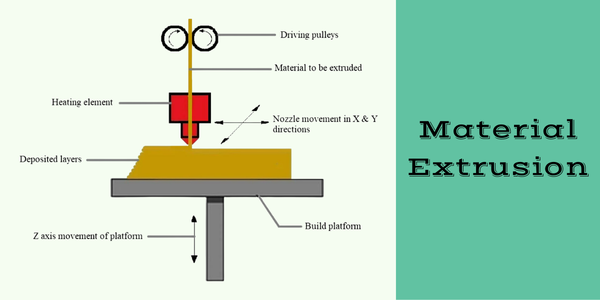
Material Extrusion is one of the most widely used 3D printing technologies in additive manufacturing. In this process, thermoplastic material in filament form is heated until it melts and then extruded through a nozzle layer by layer to build the final object. The material solidifies immediately after deposition, bonding with the previous layer to create a strong structure.
Fused Deposition Modeling (FDM)
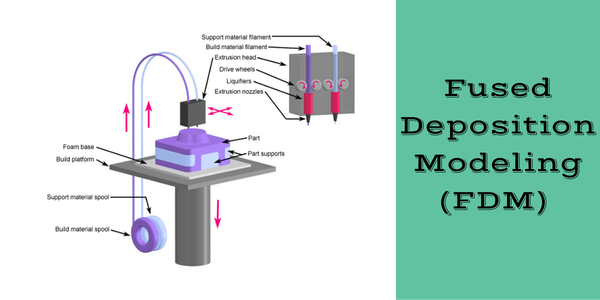
Fused Deposition Modeling (FDM) is one of the most popular and cost-effective 3D printing technologies used in additive manufacturing. In this process, thermoplastic filament is fed into a heated nozzle, melted, and deposited layer by layer to create a three-dimensional object. Each layer cools and solidifies, bonding with the previous layer to form a strong structure.
FDM printers commonly use materials such as PLA, ABS, and PETG, making them ideal for prototyping, educational purposes, and functional part production. This technology is widely adopted due to its affordability, ease of operation, and suitability for both beginners and industrial users.
Conclusion
3D printing has transformed modern manufacturing by introducing a fast, flexible, and cost-effective way to create complex objects directly from digital designs. From prototyping to full-scale production, this additive manufacturing process reduces material waste and enables high levels of customization. With various technologies like FDM, SLA, and SLS, industries can choose the most suitable method based on accuracy, strength, and application needs.
As innovation continues to grow, 3D printing is playing a major role in aerospace, healthcare, automotive, education, and product development sectors. The future of manufacturing is becoming smarter, faster, and more sustainable — and 3D printing stands at the center of this transformation.




Add comment