
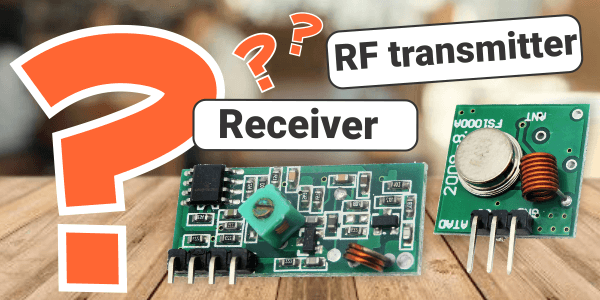
What is an RF Transmitter and Receiver?
What is RF Module?
An RF Module (Radio Frequency Module) is an electronic device used to transmit and receive data wirelessly using radio waves. It operates at a specific radio frequency and enables communication between two electronic systems without the need for physical connections.
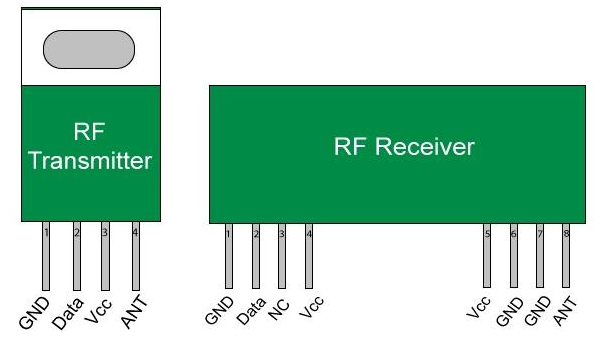
An RF module typically consists of a transmitter, a receiver, or a transceiver (both transmitter and receiver in one unit). These modules use an antenna to send and receive signals over short or long distances depending on their design and power.
RF modules are widely used in applications such as remote controls, wireless sensors, robotics, home automation, IoT devices, and RC systems.
Features of RF Module:
- Wireless data transmission using radio waves
- Operates at specific frequency bands (e.g., 2.4 GHz, 433 MHz)
- Low power consumption
- Supports short to medium range communication
- Easy interfacing with microcontrollers like Arduino
433 MHz RF Transmitter and Receiver:
A 433 MHz RF Transmitter and Receiver is a low-cost wireless communication module that operates at a frequency of 433 MHz in the ISM (Industrial, Scientific, and Medical) band. It is commonly used for simple data transmission over short to medium distances.
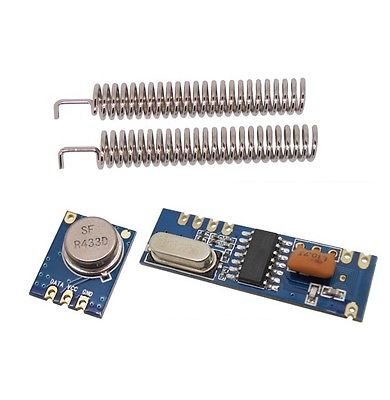
433 MHz RF Transmitter
The 433 MHz RF Transmitter converts digital data from a microcontroller into radio frequency signals and transmits them through an antenna. It sends data in the form of modulated RF waves.
433 MHz RF Receiver
The 433 MHz RF Receiver receives the transmitted RF signals through an antenna and converts them back into digital data, which can be processed by a microcontroller.
RF Transmitter Circuit Diagram
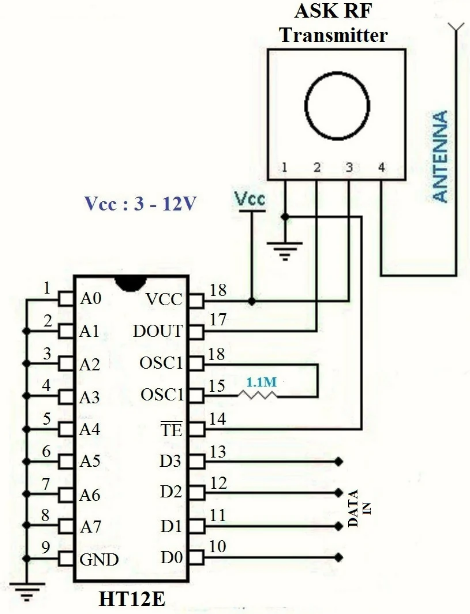
HT12E is an encoder IC that converts the 4-bit parallel data from the 4 data pins into serial data in order to transmit over RF link using transmitter.
RF Receiver Circuit Diagram
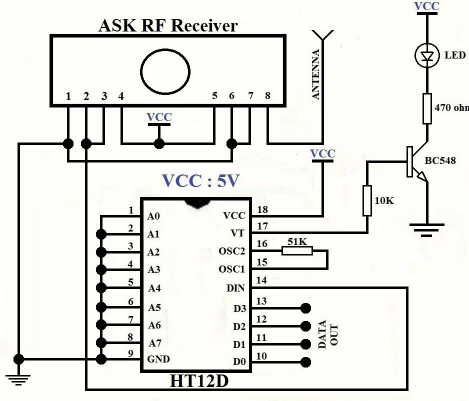
HT12D is a decoder IC that converts the serial data received by the RF Receiver into 4-bit parallel data and drives the output accordingly.
Why Encoders and Decoders are Necessary?
Encoders and decoders play a critical role in RF (Radio Frequency) communication systems, especially in wireless projects such as RC transmitters, robotics, home automation, and IoT applications. They help ensure that data is transmitted and received accurately, securely, and without interference.
What Is an Encoder in RF Systems?
An RF encoder converts multiple parallel input signals (such as switch or sensor data) into a single serial digital data stream. Along with data, the encoder adds address bits and synchronization signals, which help the receiver identify the correct transmitter.
What Is a Decoder in RF Systems?
An RF decoder receives the encoded serial data from the RF receiver and converts it back into parallel output signals. It checks the address and data integrity before activating outputs, ensuring that only the intended receiver responds.



Add comment